

Nová Bystřice is situated in the historical region of Vitorazsko. Early, sparse settlements in the area date back further, but German colonisation (by the Knights of St John) occurred during the 12th century. The land was owned by various German noble families, such as the Lords of Raabs and the Zöbings, later coming under the Vítek family’s control. From 1282, it became part of the Czech Crown under the Lords of Landštejn. By 1341, Bystřice was officially a town, and city walls were constructed. The Krajíř family owned it until the 16th century. The town was burned during the Hussite Wars, later rebuilt, and probably acquired its modern name then. The area was subsequently governed by the Lobkovicz, Kinsky, and Slavat families (including Vilém Slavat, who was famously defenestrated in Prague). During the Thirty Years' War, the region suffered only minor devastation. Later owners included the Lords of Funfkirchen. In 1774, a great fire ravaged the town. Subsequently, governance passed to various noble families, including the Trautmannsdorfs and the von Riese-Stallburgs. On 30 October 1897, the operation of a 33 km-long narrow-gauge railway from Nová Bystřice to Jindřichův Hradec commenced.
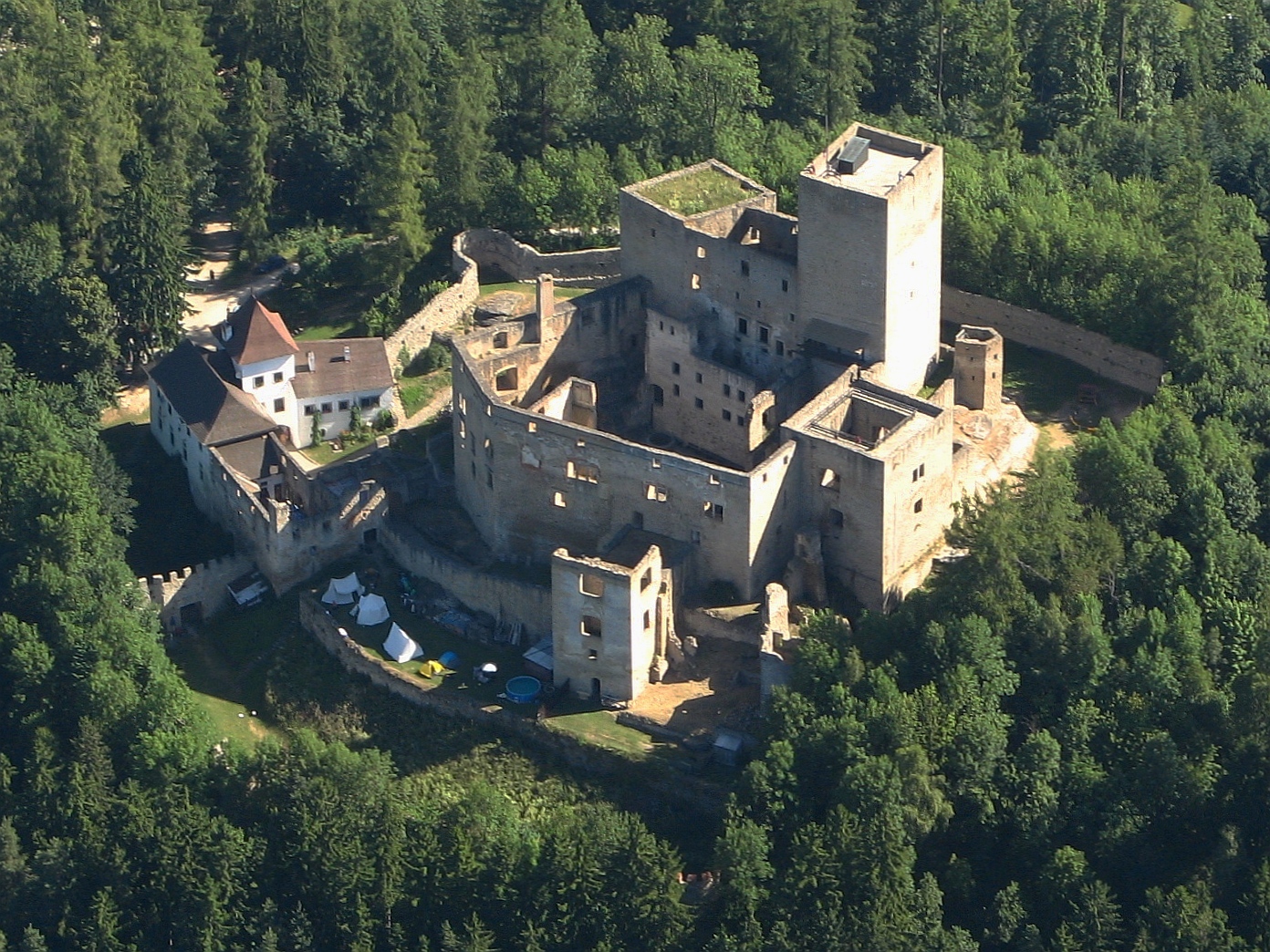
Landštejn is among the most extensive and best-preserved castle ruins in the region. Located in the wooded hills of the Nová Bystřice Highlands, it historically guarded the borders of three regions: Bohemia, Moravia, and Austria. Situated in the South Bohemian region, near Jindřichův Hradec, the northern approach leads through a Renaissance gateway from the 16th century, protecting the entrance to the forecourt with its outbuildings. Beyond the second gate lies the sloped, late-Gothic outer ward, fortified with walls and three semicircular bastions. Near the third gate, remnants of the Romanesque castle gate remain, and in the courtyard, visitors can see walls of the late-Gothic palace and the core Romanesque structure with two towers. The northern tower uniquely preserves a Romanesque chapel with an apse and gallery. The higher southern tower offers panoramic views of the surrounding landscape.
An exhibition on archaeological research is housed in one of the forecourt buildings, while the main tower contains informational panels about the castle's history. Landštejn was established in the 13th century and underwent numerous ownership changes. Although minor renovations began in the late 14th century, significant expansions and new fortifications were added in the 16th century, making it one of the largest castles in the country with its double walls. It was inhabited until the 18th century but was destroyed by lightning in 1771 and fell into ruin. A major reconstruction began in the 1970s, and the castle was reopened to the public. Its Romanesque core from the early 13th century consists of two towers and a residential palace. The main tower, with small windows and an entrance high above ground level, served a defensive purpose, while the second tower houses the Romanesque chapel. Landštejn is thought to have inspired Schiller’s drama The Robbers.
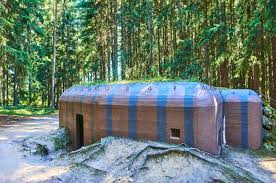
Czechoslovakia's border fortifications were constructed between 1935 and 1938 in two lines. The first line runs from Staňkovský Pond through Nová Bystřice and Slavonice to Vratěnín and remains relatively well-preserved. Near the Skalka settlement lies a unique single-embrasure structure, model E-36, a one-of-a-kind 1936 pillbox. Further west, near the road, are two bases for radar installations built by the Nazis during the Second World War. Another notable structure is the model 37 type C2 near Staré Město pod Landštejnem. A museum complex dedicated to Czechoslovak fortifications is located near Klášter II, en route to Staré Město pod Landštejnem. This includes a restored light fortification, model 37 type B, which is primarily open to visitors during summer weekends. A Czechoslovak fortifications educational trail runs from Slavonice toward Landštejn.
The only South Bohemian narrow-gauge railway links Obrataň (located roughly 8 km southwest of Pacov) with Jindřichův Hradec and Nová Bystřice. The railway was built in two stages. The section from Jindřichův Hradec to Nová Bystřice was constructed between 1896 and 1897. Following years of negotiation, a concession was finally granted in 1894, and the line was completed in just a year and a half. The first train ran in October 1897, with formal operations commencing on 11 November. The 33 km-long route features two arched bridges, five iron bridges, and one viaduct. Notably, a 2.5 km section of the narrow-gauge track is laid within the standard-gauge trackbed. In 1906, there were proposals to extend the railway into Austria, to the town of Litschau, but this was never realised. The second segment, from Jindřichův Hradec to Obrataň, was constructed between 1902 and 1906 by the Railway Cooperative of Kamenice nad Lipou. This section is 46 km long, and steam locomotives originally took 2 hours and 45 minutes to cover the distance.
 CS
CS DE
DE